Spinning Babies is a unique
way of looking at Optimal Fetal Positioning.
Spinning Babies starts with the mother's soft tissues, muscles and ligaments.
The techniques are found around the world--
"what to do when" is found right here.
Your labor can be shorter and less painful.
Easier, that is, than lying on your back in bed with a posterior baby trying to rotate into birthing position.

Click here for Hannah's Hundreds.
Make a difference.
Mother's job is to dilate--
Baby's job is to rotate!
Mother's job: The opening of the cervix is just one of the ways labor progresses during labor.
Baby's job: The baby spins around, or rotates, to fit through the mother's pelvis.
Our bodies are designed for birth. Most labors progress well when we make use of this fact.
Head down is only half the story
Which side the baby is on when labor starts matters. When baby rests, head down, with the back on the mother's left side, labor progresses best. The baby will more likely descend in an anterior position (facing back).
Labor may be longer and more complicated when the baby's back is along the mother's spine (posterior). Especially for first time mothers, when the heart beat is heard on mother's right, baby's head will more often be posterior than anterior. The posterior head fits less well through the pelvis.
Posterior labor has a less predictable pattern. It doesn't usually follow the childbirth class description of labor. Posterior labor might take longer than expected. Some posterior babies need to be delivered by cesarean surgery. Some don't. Many times, a mother can do something about it.
But all too often a mother doesn't know in time. Spinning Babies shows a mother:
What position her baby is in (Belly Mapping),
How to help a baby rotate in pregnancy or labor,
When to be concerned about your baby's position (and when not to be).
"Why didn't my doctor tell me my baby was posterior?"
These techniques are not taught in medical school. We may wish they were. A few professionals are are beginning to use these techniques. Interest is growing. But more study will have to be done to show their effectiveness to the left-brain learner.
Meanwhile, mothers and babies are benefiting from these techniques. They benefit now, before "proof" because these techniques are not invasive. Doing them does not require medical knowledge. Most of these technques can be done in the family home. Some specific techniques are done by certified or licensed health practitioners.
Spinning Babies recommends you share these ideas with your caregivers and ask if there is any medical reason not to do them. The average caregiver may not realize that a mother can do something about a malpositioned baby or a long labor, either herself, or with a little help. There are still many doctors and midwives who are not happy with the rising rates of interventions and are open to trying safe options.
Posterior labors take patience, support and know-how. Spinning Babies is the active part of patience.
Ayden listens to his brother's heart beat. Ayden himself was born posterior at home after a 12-hour labor. Not only posterior, he was posterior, asynclitic and right about 10 pounds. Using Spinning Babies techniques his mother relaxed her pelvic floor muscles and found the room to birth him without medical interventions. His little brother (gestating here) was also born posterior --and was a brow presentation! See their pictures in The Long Labor That Wasn't (Long)
How is Spinning Babies different than other Optimal Fetal Positioning approaches?
The main difference between Spinning Babies and other Optimal Fetal Positioning approaches is that Spinning Babies starts by relaxing the mother's body. Unequal ligaments and pelvic bone misalignment adversely effect how a woman's uterus is aligned, tipped and/or positiioned. The baby can only go so far in moving to an ideal birthing position if the uterus has been pulled out of balance.
I am extremely grateful to midwife Jean Sutton and childbirth educator Pauline Scott for bringing us the knowledge of (and coining the phrase) Optimal Fetal Positioning. Of course, I am. I couldn't have conceived of this website without their brilliant contribution to our modern study of childbirth!
These women taught us how the use of gravity through maternal positioning can help the baby rotate around to an easier, or optimal, position for birth.
I also want to add that the best time to focus on getting the baby into a good starting position for labor is in the 2nd trimester or early in the third trimester. But, certainly, a lot can be done later, even in labor. Labor adds the help of contractions to rotation.
The first thing to do is to start with the womb. When the ligaments are relaxed and become symmetrical the womb becomes symmetrical. Then it is lined up well with the pelvis. Then the baby can line up well with the pelvis. Read about the 1st Principle of Spinning Babies .
The baby will always get in the easiest position for birth
--whenever the baby finds it possible to do so.
Reduce the possibility of back labor, long labor or cesarean surgery.
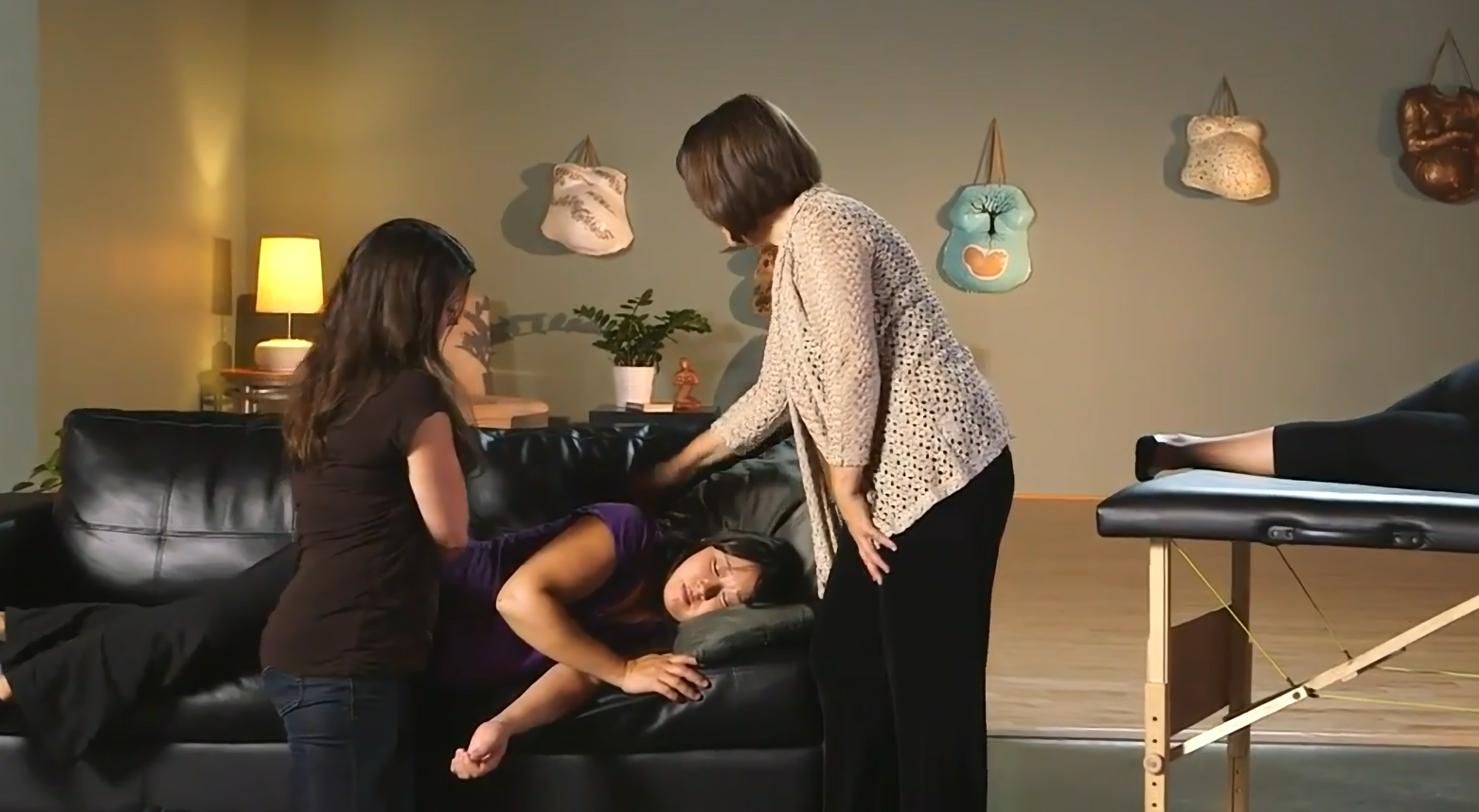
Spinning Babies does not involve manipulation of the baby. Spinning Babies uses techniques the mother can do herself or her partner, nurse or doula can help her with. It's best to start in early to mid pregnancy. But most of the time, these techniques are also successful in later pregnancy and labor itself.