To interpret by paradigm helps us to explain something that is not actually fully knowable by creating a story map to share an understanding with one another. We are drawn into any paradigm by social agreement first, being raised to think a certain way, or educated to, through school and also conversations.
A paradigm is like a perceptual, or mental, map of the world. It’s how we arrive at conclusions and how we make decisions.
If our paradigm is accurate, we find our ways to solutions and interactions that fulfill our expectations. But if our paradigm isn’t accurate or is biased, we miss the fullness possible with a better paradigm.
Our paradigms direct our search for solutions. For example, in health, the paradigm that germs are the cause of disease invites solutions through hygiene and the elimination of microbes but misses other solutions such as nutrition and breath work. In essence, paradigms give reason, describe what the challenges are, and set the shortcuts or imagined obstacles.
In birth, the paradigm shapes the reasoning for our practice decisions.
“If you want to make minor, incremental changes and improvements, work on practices, behavior or attitude. But if you want to make significant, quantum improvement, work on paradigms.” Stephen Covey, is known for teaching principle-centered leadership. This quote is from his book, The 8th Habit, page 19.
There have been two pressures on practice in the decades I’ve been serving birthing families:
1. To reduce the cesarean rate
2. To justify a high cesarean rate
The order can be reversed.
As placenta accreta and other complications of birthing by uterine surgery rise in occurrence with higher cesarean rates, pressure to reduce the cesarean comes in minor practice changes.
Longer second stages or more tolerance for VBAC are important but relatively minor practice changes that increase rates of vaginal birth. So recent decades show a see-saw of cesarean rates reflecting economic pressures unguided by the art or science of obstetrics.
The paradigm of modern medicine remains industrial. Birthing families are capital, reproduction is a commodity. The US exports the industrial model which has little tolerance for upright birth positions, breech birth, or continuity of care for birthing families.
Creativity, listening, and time for social solutions for birth as a social-sexual process is not even on the map of the industrialized birth paradigm. Doctors and midwives who practice in ways that serve individual needs beyond the production line are weeded out. In my city, three years seems to be the career peak of doctors that embrace the VBAC community, for instance.
Meanwhile, the industrial birth paradigm induces and produces or the babies are just cut out. No time to explore the inner needs of pregnant people and babies or even the social impact of treating people like production inventory. Love, trust and social stability need a social side of birth.
In contrast, the Spinning Babies® paradigm addresses the physical expression of birth with the goal to increase the ease of birth. The paradigm brings pregnant people and babies together immediately and reduces reasons to interrupt the lifelong learning about one another that begins and depends so much upon birth.
I sought solutions for posterior presentations. This was my personal quest. I wanted to be more helpful to the birthing people asking me to support natural birth even if the baby was OP. I also became a doula trainer to grow a community of skilled companions for birthing families.
Seeing the gaps in understanding moved me to bridge the gaps with knowledge and thinking suitable to them, often hands-on learning styles of the doulas I taught. Rather than share midwifery methods of assessment, the limits of the Doula Scope of Practice demanded creative new ways to perceive the signs and signals of labor progress, labor pause or stall.
So by virtue of limitation, I created systems of assessment and resolution available to the doula. What came as a surprise to me was that these systems also met the needs of midwives and nurses who were not being served by the limits of their own practices of vaginal exams of the cervix.
For my awareness of the Doula Scope of Practice, we are all deeply grateful to Penny Simkin and her integrity and value of the doula’s unique role. The peer of the parent has a power of welcoming the birthing person to the circle of parenting in a way that the expert can’t, even though they offer other important meaning and care. This modern hybrid of community elder is a modern society’s answer to the birth companion where a community elder is no longer available.
Creativity out of limitation evolved into Spinning Babies®. The refinement of scope to serve the needs of providers and doulas to serve birth with a body-centered wisdom.
Physiology Before Force
Physiology is more than a hormonal drip from the brain to the blood. Physiology includes the response of the body as well as the initiation of the response.
The more we learn about physiology the more we attribute human function, mood, and well being.
Before Force
We can’t provide comprehensive birth services without the occasional intervention. However, until physiological approaches with social support, midwifery, and Spinning Babies® lead practice, we will still be back in the industrial paradigm of “Induce and Produce”.
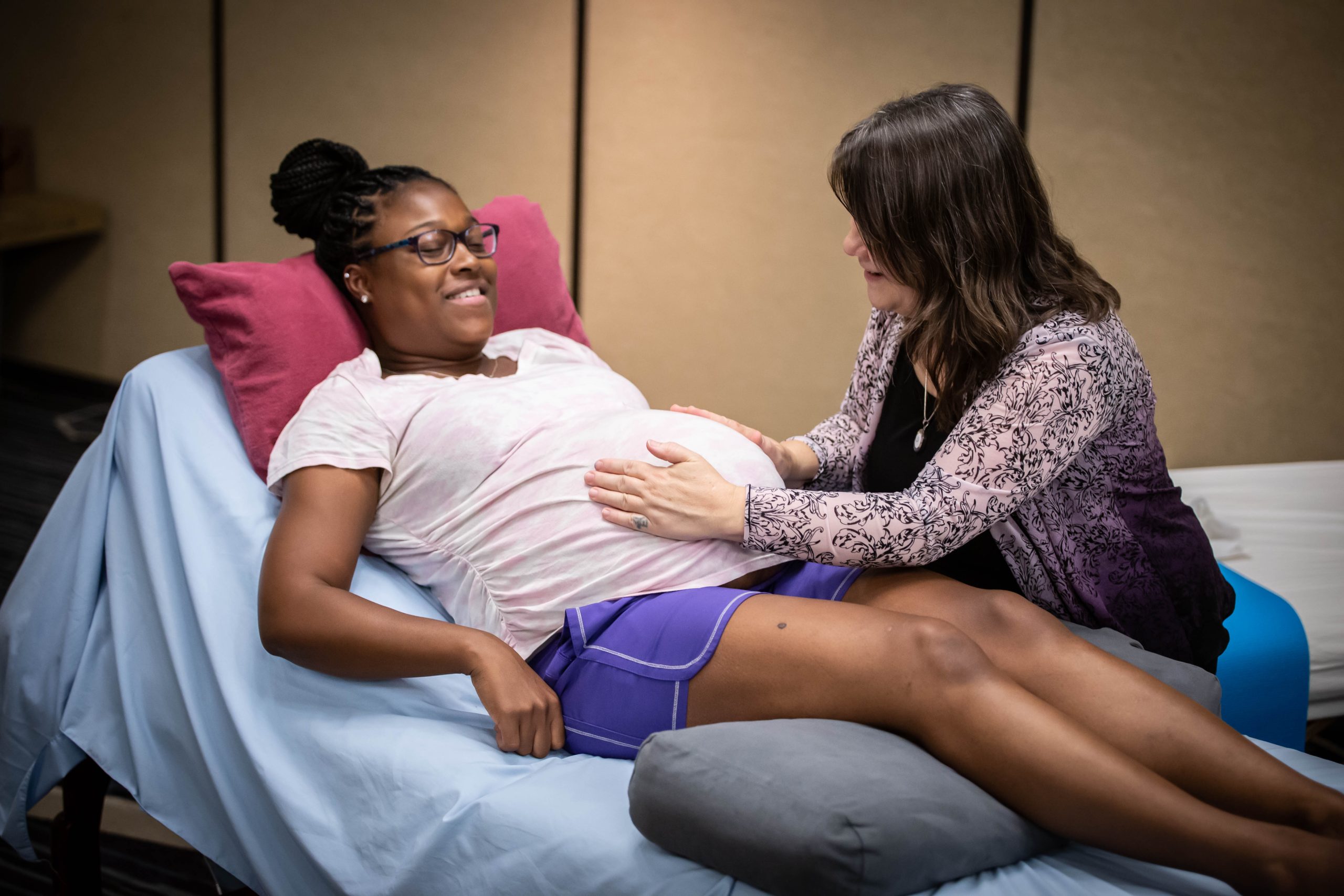
Spinning Babies® Three Principles of balance, gravity, and movement gives the most gentle guidance to begin the shift. I say, balance first to encourage activities to restore body balancing, releasing what’s tight, supporting what’s loose, and untwisting the torsion of previous sudden stops in gravity, or persistent twists in body mechanics. After that we find our pelvic positioning to be much more effective for easing childbirth.
We fulfill the opportunity nature intended. This is being a steward of nature, not a manager or dominant “mind”. Birth is led by birth. Enter the paradigm. Take our Foundational Workshop, and go on afterward to take a training course, such as the Spinning Babies® Aware Practitioner or become a Certified Birth Professional. Share your new love of Spinning Babies® with parents in your childbirth education services.
Find out how you might fit teaching Spinning Babies® into your birth or pregnancy services by clicking here.