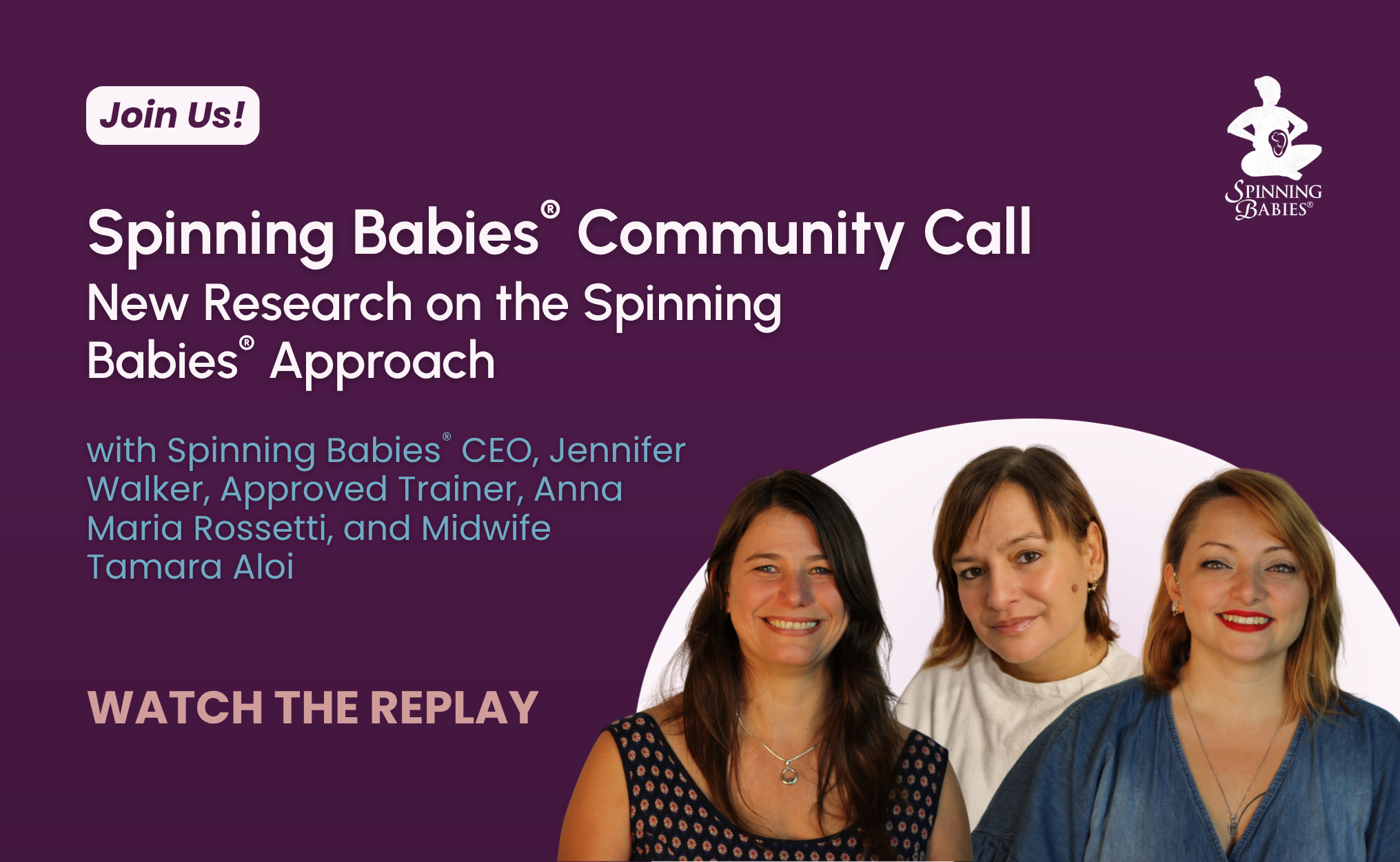
On November 5, 2025, Spinning Babies® hosted a virtual community call on Zoom with CEO Jennifer Walker, Approved Trainer Anna Maria Rossetti, and Midwife Tamara Aloi. This gathering brought together birth professionals from around the world to discuss a newly published article in the European Journal of Midwifery, one of the first peer-reviewed studies to specifically look directly at Spinning Babies® for fetal rotation during labor.
For many in our community, this conversation felt like a moment where research finally put language to the patterns providers have observed for years while applying Balance before Force and the Pelvic Levels Solutions℠ framework.
A Collaboration Rooted in Real-World Practice
Anna Maria’s work at the Scuola Elementale di Arte Ostetrica (SEAO), together with her role as a Spinning Babies® Approved Trainer, has contributed to ongoing conversations about midwifery-led education and physiological birth in Italy. She and Tamara are contemporaries who attended midwifery school together, and their commitment to physiology has continued to shape their professional paths. After attending one of Anna Maria’s Spinning Babies® workshops, Tamara began integrating what she learned into her clinical practice. The impact she observed in her own hospital setting became the spark that led to this study’s development.
Their shared perspectives brought a grounded discussion on the research and the Spinning Babies® Approach:
- how restoring balance can influence comfort and soft-tissue mobility
- how the Pelvic Levels Solutions℠ framework helps providers see where rotation may stall – and why
- how this approach can support progress, even in medically busy environments
- how the question Where’s Baby? reframes labor from dilation alone to understanding flexion, rotation, and decent
Jennifer brought the broader vision into focus: this research aligns with a global shift toward physiology before force, and toward recognizing the baby as an active participant in navigating the pelvis.
The chat quickly reflected provider alignment: “yes, this is what we see too.”
What the Study Shows
This study is one of the first peer-reviewed publications to examine fetal rotation from occiput-posterior and occiput-transverse positions using the Spinning Babies® approach. It found a significantly higher rotation to anterior among those who received the approach compared to controls, adding research support to what many providers have observed for years through applying Balance before Force and the Pelvic Levels Solutions℠ framework.
For context:
- 93.3% of those using the Spinning Babies® approach rotated from posterior or transverse to anterior
- 63.6% of the control group rotated
- The approach was associated with a 45% increased likelihood of anterior rotation
Watch the Recording
If you missed the call or would like to revisit the conversation, we are happy to share the full recording. It is available in Italian with English captions.
Watch the full recording:
https://www.youtube.com/watch?v=RfQAjQRwmOc
Watch the English highlights:
youtu.be/HyJEtuho3bw?si=odpIYJSt2Q7ScADF
How to Turn on Captions and Translations
To view captions or translate them into your preferred language:
- Click the CC icon in the bottom right corner of the video player, or tap the CC icon on mobile.
- If you do not see the CC icon, open the gear icon or three dot menu and select Subtitles or Captions.
- To change the language or translation, click the gear icon and choose the option you prefer under Subtitles.
Thank You for Being Part of Our Community
Thank you for reading and for joining us in exploring new research and real-world experience. Wherever you are in your journey, we’re grateful you’re part of this growing conversation about physiological birth.