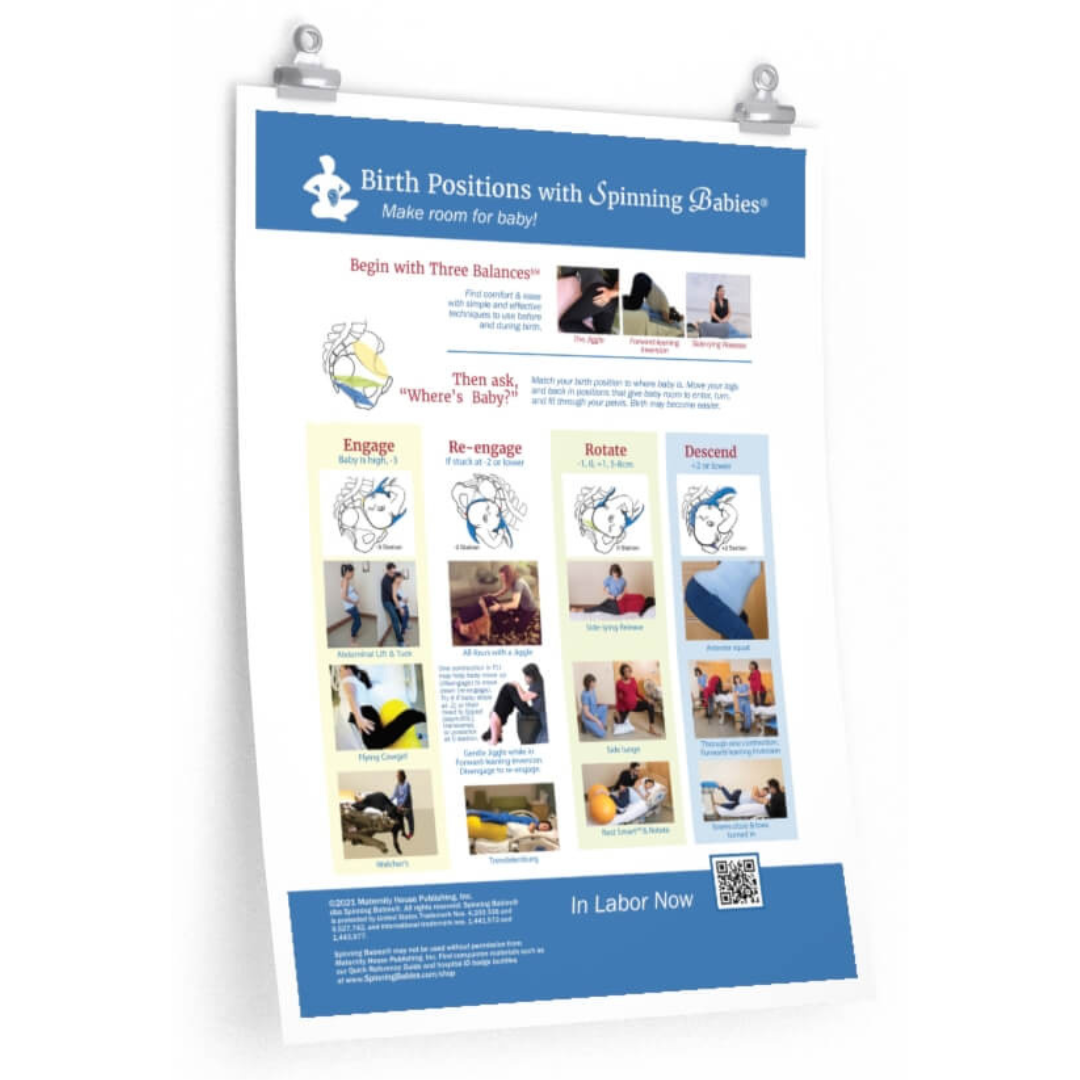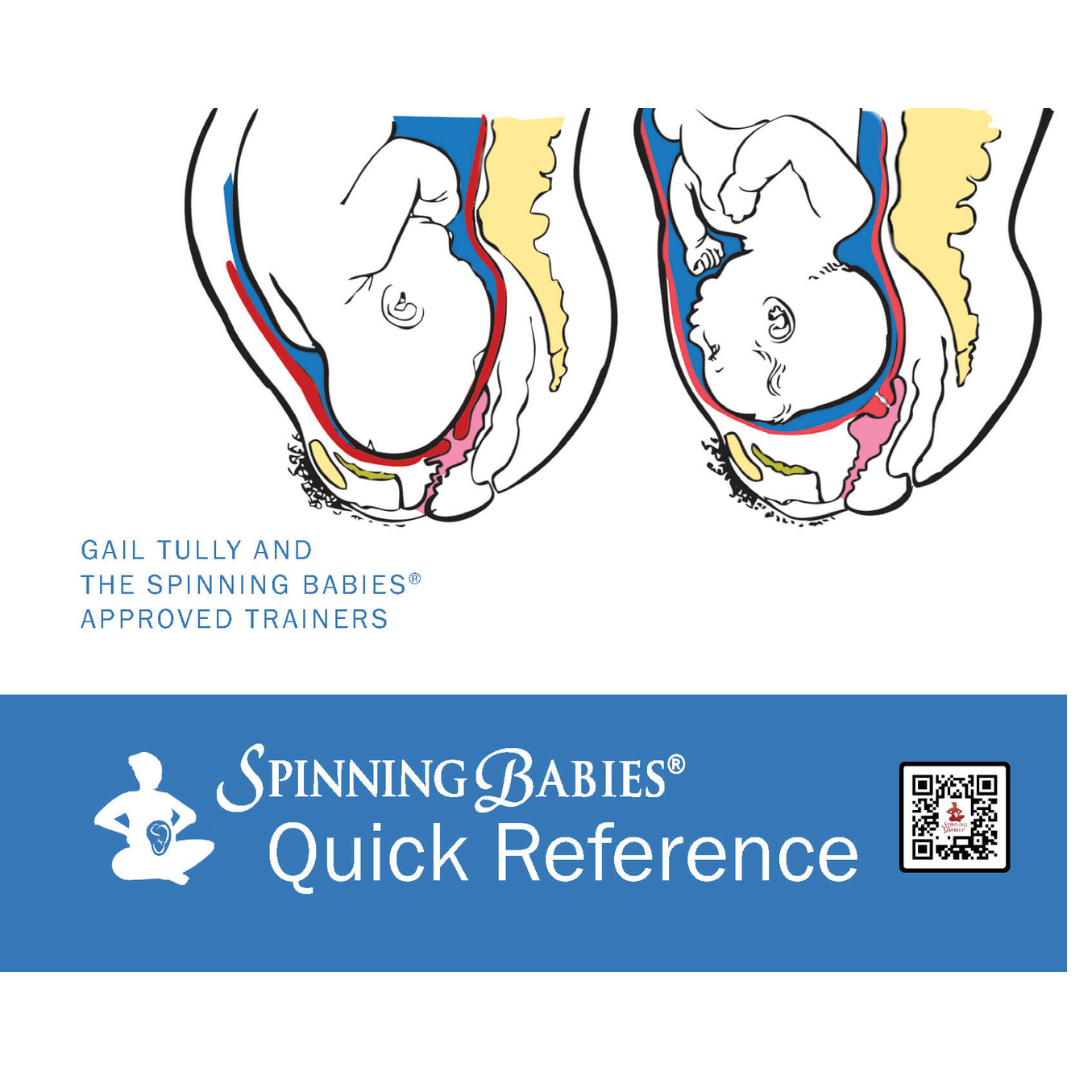
The Jiggle is first in The Three Balances℠ arrangement of our favorite recommended techniques. Jenny Blyth developed The Jiggle as part of her Birthwork Workshops in Australia. We are delighted to offer her technique in our Spinning Babies® approach.
The gentle rhythmic movement of The Jiggle invites softness and relaxation.
We’re not shaking the body to force a change of baby’s position. The Jiggle reflects a physiology-first approach, awakening receptors through a fluid vibration inside the connective tissue.
Comfort and ease begin with softness. Many families and birth professionals experience an awakening of the calming part of the nervous system, and that becomes not only a technique but a reminder that we are our body, too.
Letting the weight of the uterus hang from its ligaments invites a stretch response that may lead to balance and space. This way of using gravity during pregnancy and birth is not necessarily to remove baby from the pelvis but rather to align the womb, open the space to let baby get into a head-down position, engage the head-down baby to start labor in a more ideal position, or come down onto the cervix and through the pelvis in labor.
Forward-leaning Inversion is the second of The Three Balances℠ that elevate the Spinning Babies® approach. Originating from Dr. Carol Phillips, DC, this unique position offers specific benefits. Before you go upside down, read our safety guidelines and contraindications on our webpage. Avoid if there is high blood pressure.
Within the Spinning Babies® approach, Forward-leaning Inversion supports comfort by letting the weight of the uterus unwind tension in uterine ligaments to enhance uterine function and pelvic suppleness for pregnancy and labor.
Rather than focusing on correcting a problem (like breech or posterior fetal positions), our practices reflect a physiology-first perspective. We invite your curiosity, observation, and a deeper understanding of how the body’s soft tissues, like uterine ligaments, respond to a gentle shift to the Forward-leaning Inversion position and the movement back up to high kneeling.
For many families and birth professionals, Forward-leaning Inversion becomes part of a broader approach to supporting balance, mobility, and ease throughout pregnancy and birth. Read the contraindications on our website to avoid a fall or a head-down baby going breech.
Side-lying Release is the third of Spinning Babies® Three Balances℠ recommended techniques and comes from Dr. Carol Phillips, DC. Avoid if there is hypermobility, like Ehlers-Danlos Syndrome.
This gentle, slow, static stretch invites muscle tension to release inside the pelvis and lower back during pregnancy and birth.
Correct alignment of the hips and shoulders during a Side-lying Release may encourage greater suppleness in the pelvic floor (temporarily) and pelvic mobility at the S. I. joints. Less pain and more comfort are common results, and more ease for baby’s rotation to fit through the pelvis.
Side-lying Release as a practice reflects a physiology-first perspective that values observation, comfort, and working with the body rather than against it.
For many families and birth professionals, Side-lying Release becomes an opportunity to pause, listen more closely to the body, and create space for greater ease and comfort throughout pregnancy and birth.
We used to call the Three BalancesSM techniques by the name The Three Sisters of Balance to emphasis the synthesizing effect similar to The Three Sisters agricultural practice of the Haudenosaunee, or Iroquois Confederation of Five Tribes (and after 1722, the Six Tribes), in the region that is now the northeast of the USA. In small mounds of earth squash, corn, and beans were planted together. Each plant puts nutrition into the soil that is needed by the other. Variations of the Three Sisters were used in Mesoamerica, including a 4th sister, a flower to attract bees! We honor the wisdom that precedes us.
Our intent by using the name Three Sisters of Balance was to raise respect in the predominantly white culture in which I teach. Labeled as cultural appropriation gives me pause to consider the use of the words, Three Sisters. Would I then become another white person who can’t see Native presence in the world? Would I add to Native invisibility? I sat with my colleague, Pat Welch of the Turtle Women Doula Program who revolutionized care for St. Paul Indigenous families by introducing Indigenous doula care in the 90s. She was able to reduce the rate of premature birth to almost zero! I was honored to work closely with her during the initial program creation and first year, including being a doula trainer with her. We sat, in this instance, with a board of decision makers seeking to reduce racial disparities in birth. At no time in the meeting were Native neonatal mortality mentioned until Pat Welch spoke up. She talked about the invisibility of her people in government policies. I find this continues all too often. While I am a birth activist I would like to do a small part to add visibility in an engaging and meaningful way to the 100s of thousands of people visiting Spinning Babies®.
My intent was to recognize wisdom and break down ignorance and compartmentalization. When some of the white audience hear the brief attribution in our workshops, barriers fall. Physiology in society improves. The “body” of the world is less violently separated and a tender thread of connection is made. My hope was that some of the ignorance about Indigenous culture is reduced.
Thinking of the body as a system of separate organs is similarly disconnecting organs from the landscape of the human whole. Fascia is removed from the cadaver and only then is the anatomy studied. We lost the connecting factor!
Combining the jiggle and a stretch reaches the fascia in complementary ways. We picked three specific techniques to reach fascia throughout the pelvis and soft tissues inside it. Our arrangement is branded but the techniques are not. We honor the teachers that created light along the way. Even when we change and grow, we remember roots of development and seek to express respect in the era we live.
Continue exploring the Spinning Babies® approach with resources you can use during pregnancy and birth preparation:
Looking for individualized, hands-on support? Search the Professional Directory to find a Spinning Babies® Aware Practitioner or another credentialed professional near you.
Ready for hands-on learning? Find a Foundational Workshop or explore Spinning Babies® workshops, trainings, and professional pathways.